Tuesday, April 21, 2026
82.6 F
Lagos
More
    Home Blog Page 472

    Sudan Conflict Causes Evacuation of Kenyan Citizens: Over 400 Fatalities and Thousands Injured In Escalating Sudanese Army and RSF Fighting

    0
    Read Time:2 Minute, 12 Second

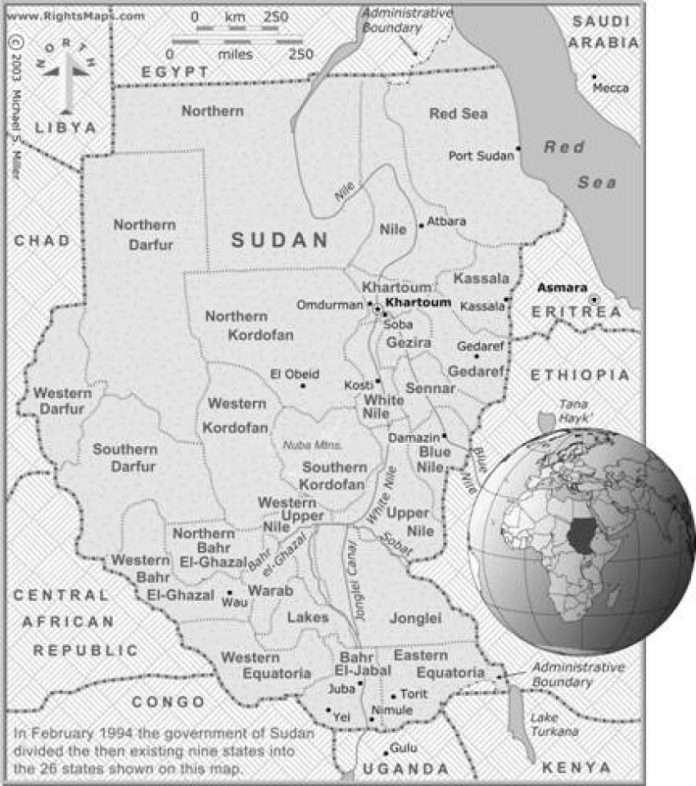
    Khartoum, Sudan- (African Boulevard News) – Kenya has launched a mission to evacuate its citizens from Sudan due to the escalating conflict between the Sudanese Army and the paramilitary Rapid Support Forces (RSF), which has now entered its second week. The situation in Sudan has deteriorated rapidly, with over 400 fatalities and thousands of injuries reported since last Saturday. Kenya has now joined other countries, including the United States, the United Kingdom, France, Germany and Canada, who have already evacuated some of their citizens.

    Permission granted by neighboring countries

    Foreign Affairs Cabinet Secretary Alfred Mutua confirmed that neighboring countries, including South Sudan, Ethiopia, Egypt, and Saudi Arabia, have granted permission for Kenyan planes to overfly their airspaces to evacuate stranded Kenyans in Sudan. Furthermore, the Ministry of Foreign and Diaspora Affairs has three active evacuation programs underway.

    Kenyan students safely evacuated

    The Ministry of Foreign and Diaspora Affairs has facilitated the crossing of 29 Kenyan students to Ethiopia, where they will fly to Gondor and then to Addis Ababa before heading to Nairobi. Additionally, a Kenya Airforce plane has been deployed to evacuate a group of 18 students currently traveling by road to the South Sudan border.

    Two aircraft to evacuate larger group

    According to Mutua, a larger group of Kenyans will be evacuated via two aircraft from Port Sudan to Jeddah, and then travel to Nairobi by Kenya Airways. He estimates that “300-400 Kenyans, if not more,” will be evacuated through this method. Mutua commended the Kenya Foreign and Diaspora staff on their missions in various countries and the multi-agency teams in Nairobi for their seamless coordination.

    Concerns over the stability of the region

    Last week, President William Ruto urged the warring parties to comply fully with the resolution of the Inter-Governmental Authority on Development (IGAD) Heads of State Summit held on Sunday. Ruto called on General Abdel Fattah al-Burhan, the leader of the Sudanese Armed Forces (SAF), and Mohamed Hamdan Dagalo, popularly known as Hemedti, who heads the paramilitary Rapid Support Forces (RSF), to immediately stop fighting and allow dialogue to take place. The President expressed his concern over the worsening situation in Sudan, which he said threatens the stability of the region and the entire continent.

    Coordinated evacuation efforts

    As the situation in Sudan continues to escalate, Kenya is taking swift action to ensure the safety of its citizens. With permission granted by neighboring countries and the coordinated efforts of the Ministry of Foreign and Diaspora Affairs, Kenya hopes to safely evacuate its citizens from the conflict zone. Although the situation remains tense, Kenya remains committed to ensuring the safety and security of its citizens.


    Kenya Evacuates Citizens from Sudan amid Escalating Conflict: Human Rights Abuses and Crisis Raise Alarms in the International Community.

    0
    Read Time:2 Minute, 32 Second

    Kenya launches evacuation operation from Sudan amid escalating crisis

    Kenya has launched an operation to evacuate its citizens from Sudan due to the ongoing conflict between the Sudanese Army and the paramilitary Rapid Support Forces (RSF), which has now entered its second week. The escalating crisis has forced hundreds of Kenyans to flee the country.

    The conflict

    The conflict began after the ousting of former President Omar al-Bashir in April this year. The transitional military council, which took over after al-Bashir was deposed, signed a power-sharing agreement with the opposition in August. However, tensions have risen in recent weeks between the military and the opposition over the transitional government’s composition and the role of the RSF.

    The RSF, which has been accused of being responsible for human rights abuses in the country, including the recent killing of peaceful protesters, has been a source of concern for many in Sudan. The paramilitary force is made up of former Janjaweed militias who were involved in the Darfur conflict.

    Kenya’s evacuation operation

    According to the Kenyan government, the evacuation operation was launched to ensure the safety and security of its citizens in Sudan. The operation involves the use of two Kenyan Air Force planes, which began airlifting citizens out of the country on Sunday.

    “We have started an operation to bring Kenyans out of Sudan… We urge those in the affected areas to take advantage of this operation,” said Monica Juma, the Kenyan Foreign Affairs Cabinet Secretary.

    Kenya’s embassy in Khartoum has been working closely with the Sudanese authorities to help facilitate the evacuation process. The embassy has also urged Kenyan citizens to stay away from areas where there are demonstrations or violence.

    Reactions to the crisis

    The crisis in Sudan has attracted attention from across the world, with many countries and international organizations expressing concern over the situation.

    The United Nations has called for an investigation into the killing of peaceful protesters by the RSF, while the African Union has suspended Sudan, saying that the military council’s actions pose a threat to peace and security in the region.

    In Kenya, the opposition has criticized the government’s response to the crisis in Sudan, with some accusing the government of not doing enough to help Kenyan citizens in the country.

    The way forward

    The ongoing conflict in Sudan has created an uncertain future for the country and its citizens. With tensions rising and the situation on the ground becoming increasingly volatile, it is unclear what the future holds for Sudan.

    However, the evacuation of Kenyan citizens from the country is a positive step towards ensuring their safety and security. The Kenyan government has urged other countries with citizens in Sudan to take similar measures to evacuate them from the conflict zone.

    In the meantime, it is essential that the international community continues to place pressure on the Sudanese authorities to bring an end to the conflict and to hold those responsible for human rights abuses accountable. Only then can the country move towards a peaceful and stable future.

    Ethiopian government to hold peace talks with Oromo rebel group

    0
    Read Time:2 Minute, 47 Second

    Addis Ababa, Ethiopia- (African Boulevard News) – Ethiopia’s Prime Minister Abiy Ahmed has announced that peace talks will begin on Tuesday with the Oromo Liberation Army (OLA), a rebel group that has been active in the country’s largest and most populous region of Oromia. The talks will take place in Tanzania and the OLA has confirmed its participation.

    Peace talks to ease Ethiopia’s internal strife

    The Ethiopian government and the OLA have been in conflict since 2018, with accusations on both sides of violence and human rights abuses. Oromia, where the conflict is focused, has been the scene of ethnic massacres and communal animosities. The situation has become increasingly confused, with internal political struggles and territorial disputes further complicating matters.

    The talks present an opportunity to ease tensions and resolve the conflict that has affected the lives of millions of Ethiopians. Both sides have agreed to the participation of an independent third party mediator and a commitment to maintain transparency throughout the negotiation process.

    OLA’s call for peaceful dialogue

    The Oromo Liberation Army has consistently called for peaceful dialogue as the only viable solution to the conflict. The organisation has welcomed the Ethiopian government’s decision to engage in talks and confirmed its acceptance of the conditions for peace negotiations. The OLA has given birth to a nebulous group of armed groups claiming to be its own but with loose links.

    The OLA is estimated to have a few thousand men and observers consider it insufficiently organised and armed to pose a real threat to the federal government. However, the OLA has been accused by the government of being responsible for ethnic massacres that have taken place in Oromia. The OLA rejects these accusations and maintains that the government’s indiscriminate repression fuels Oromo resentment against the federal government in Addis Ababa.

    Unclear details of the talks

    Neither Prime Minister Abiy nor the OLA has specified who the mediator will be, in which city the talks will be held and in what format. It is uncertain whether the mediation team will be composed of local or international actors.

    The talks will take place during a period of political uncertainty in Ethiopia, with elections postponed to an indefinite date and ongoing conflicts in several regions of the country. The peace agreement signed on 2 November in Tigray, in northern Ethiopia, ended two years of conflict between the Ethiopian government and regional authorities who rebelled against the federal government.

    The way forward for Ethiopia

    The peace talks with the OLA offer a glimmer of hope for the resolution of a conflict that has resulted in loss of life and displacement of communities. The talks also present an opportunity for the Ethiopian government to show its commitment to peaceful resolution of conflicts in the country.

    The situation in Oromia is complex and requires a comprehensive approach that addresses the root causes of the conflict. The talks are a step towards finding long-term solutions to the grievances of the Oromo people.

    As the talks begin, stakeholders must ensure that they are grounded in the principles of inclusivity and accountability. The international community must also lend its support to ensure the success of the peace process.

    Ethiopia is at a critical juncture in its history, and the outcome of the peace talks with the OLA will have a significant impact on the country’s future.

    Tunisia’s Coastguard Intercepts 372 Migrants in Latest Rescue Mission off Sfax, Amid Calls for Greater Cooperation to Address Crisis of Migration.

    0
    Read Time:2 Minute, 37 Second

    Tunis, Tunisia- (African Boulevard News) – Last Monday, the Tunisian coastguard intercepted 372 migrants off the coast of the port town of Sfax, approximately 250km (200 miles) south of capital Tunis. The migrants were attempting to leave the shores of the North African country in small and unseaworthy boats. This interception is the latest in a series of similar operations carried out by the Tunisian coastguard in recent months.

    The Intercept

    The coastguard used speedboats to intercept the migrant vessels which were overloaded and at risk of being swamped by even a small wave. These boats are often built to order in small workshops in and around Sfax, and despite police efforts to crack down on their production, it hasn’t stopped.

    The Migrants

    The migrants who were intercepted told reporters that they had hoped their vessel would carry them into international waters from where they might be rescued and taken to Europe. They were attempting the sea journey from far and wide, with many from Bangladesh and Syria, but the majority on this night were from sub-Saharan West Africa.

    Some are fleeing war in their countries, while others are hoping to get jobs or join family in Europe. Many of them spoke of suffering racist abuse in Tunisia. Africans living in Tunisia have come under pressure recently, kicked out of their accommodation and losing their jobs after a wave of racist sentiment against them was inflamed in February when President Kais Saied ordered a crackdown on sub-Saharan African migrants and lashed out at a perceived plot to erase Tunisia’s identity.

    The Return

    Instead of reaching international waters and being rescued, the migrants were brought aboard a coastguard cutter and were later returned to Tunisia. After the migrants are stopped, they are brought aboard the coastguard ships, and their boats are collected later by the authorities.

    Most migrants are released as soon as they are brought back to shore, with many hoping to attempt the trip again as soon as possible. Officials say that every night when the seas are calm, scores of overloaded migrant boats set off on a perilous journey.

    The Call for Cooperation

    The coastguard says it has stopped 13,000 people attempting to depart by sea illegally in the first quarter of 2023. They are calling for close cooperation with neighboring Italy and Malta and say that their work is hindered by several of their ships being out of service for repairs.

    The Way Forward

    While the situation with migrants leaving Tunisia continues, it is important to address the root causes and find ways to create opportunities for these people in their home countries. Many of them are only leaving because of war, poverty, or persecution, and their goal is to have access to better lives elsewhere.

    As the world struggles with the issue of migration, it is crucial that countries work together to find solutions that provide safe pathways for people to migrate and ensure that vulnerable migrants are not exploited on their journey. The Tunisian coastguard’s interception highlights the need for a coordinated approach to address the crisis of migration, which affects millions of people around the world.

    Sudan and Egypt collaborate to evacuate citizens amidst tensions – 436 Egyptians repatriated from safe areas, joint efforts reflect long-standing ties.

    0
    Read Time:2 Minute, 4 Second

    KHARTOUM, Sudan.- (African Boulevard News) – In a bid to rescue its citizens residing in safe areas of Sudan, Egypt’s Foreign Ministry announced the evacuation of 436 Egyptian nationals from Sudan by land. The move comes as part of the evacuation plan for Egyptians from Sudan, according to Foreign Ministry spokesman Ahmed Abu Zeid.

    Egypt’s Operation to Rescue Its Citizens

    Earlier on Sunday, the Egyptian government had announced the onset of operations to evacuate its nationals from safe areas in Sudan, in coordination with the Sudanese authorities. The evacuated citizens were instructed to head to meeting points to begin their journey back home.

    Collaborative Efforts

    Egypt’s embassy in Khartoum, consulates in Khartoum and Port Sudan, and the consular office in Wadi Halfa in northern Sudan have collaborated with the citizens to secure their safe repatriation. This joint effort between Egypt and Sudan reflects their longstanding diplomatic ties, focused on cooperation and mutual assistance.

    The Need for Evacuation

    The evacuation operations come amidst mounting tensions and violent clashes between the Sudanese authorities and Egyptian nationals residing in the country. Reports from the ground reveal that several Egyptian nationals have been killed and injured in these clashes, prompting the need for swift evacuation and repatriation to avoid further loss of life.

    Evacuation as a Priority

    The Egyptian government has been keeping a close eye on the security situation in Sudan and has made evacuation and repatriation of its citizens a high-priority exercise. It has urged its citizens not to travel to Sudan until the situation stabilizes and has advised those already in the country to remain cautious and avoid areas of tension.

    Longstanding Diplomatic Ties

    Egypt and Sudan have long-standing diplomatic ties, underpinned by a history of close cooperation in various fields. While the recent unrest in Sudan has raised concerns for the safety of Egyptian nationals in the country, their repatriation is being closely coordinated between the two countries, reflecting their strong partnership and commitment to mutual support during times of crisis.

    The successful evacuation of 436 Egyptian nationals from Sudan by land is a testament to the collaborative efforts of Egypt and Sudan to secure the safety of their citizens. The two countries have worked closely together to ensure the safe return of Egyptian nationals to their home country, amidst ongoing unrest in the Sudanese capital. The evacuation plan is a testament to the strong diplomatic ties between the two countries, and their commitment to working together to tackle crises and protect their citizens.

    Egypt Evacuates 436 Citizens from Sudan in Land Rescue Effort: A Tale of Cooperation and Strength Amid Crisis

    0
    Read Time:2 Minute, 45 Second

    436 Egyptian Citizens Evacuated From Sudan By Land in Historic Rescue Effort

    The Foreign Ministry’s Rescue Effort

    In a historic rescue effort, the Egyptian Foreign Ministry has successfully evacuated 436 Egyptian citizens from Sudan by land. According to the Foreign Ministry, the evacuation process began on Sunday 23/4/2023, with the citizens being transported safely across the border into Egypt.

    The evacuation was carried out in response to the deteriorating security situation in Sudan, which has seen a sharp rise in violence and instability in recent months. With many Egyptian citizens living and working in Sudan, the Foreign Ministry took swift action to ensure their safe return to Egypt.

    The Challenge of Evacuation

    Evacuating such a large number of citizens from a neighboring country posed a significant challenge for the Foreign Ministry. With limited resources and infrastructure in place, the ministry had to work quickly and efficiently to organize the rescue effort.

    Thanks to the tireless efforts of ministry diplomats and staff, the evacuation was completed without incident. The citizens were transported in convoys of vehicles, which were protected by Egyptian security forces throughout the journey.

    The Importance of Cooperation

    The success of the evacuation was due in no small part to the cooperation of the Sudanese authorities. The government of Sudan provided essential support and assistance to the Egyptian officials throughout the process, helping to ensure the safe passage of the citizens.

    In a statement, the Foreign Ministry expressed its gratitude to the Sudanese authorities for their cooperation, stating that “this operation would not have been possible without their invaluable assistance.”

    A Welcome Homecoming

    For the 436 Egyptian citizens who were evacuated, the return to Egypt was a welcome homecoming. After months of uncertainty and instability in Sudan, they can now rest easy, knowing that they are safe and sound on home soil.

    Many of the citizens expressed their gratitude to the Foreign Ministry, thanking them for their hard work and dedication in securing their safe return. They also praised the Sudanese authorities for their cooperation, highlighting the importance of good relations between neighboring countries in times of crisis.

    A Show of Strength

    The successful evacuation of 436 Egyptian citizens from Sudan by land is a powerful reminder of the strength and determination of the Egyptian government. In the face of adversity, they have demonstrated their commitment to protecting and serving their citizens, regardless of the challenges that may arise.

    It is also a testament to the power of cooperation and collaboration between neighboring countries. By working together towards a common goal, Egypt and Sudan were able to overcome the obstacles that stood in the way of the evacuation, ensuring the safe return of hundreds of Egyptian citizens.

    A Bright Future Ahead

    As Egypt and Sudan move forward from this crisis, there is hope for a bright future ahead. By building on the cooperation and goodwill that was demonstrated during the evacuation, the two countries can continue to strengthen their ties, promoting peace, stability, and prosperity across the region.

    For the 436 Egyptian citizens who were evacuated, their return to Egypt marks the start of a new chapter in their lives. They can now look forward to a brighter future, safe in the knowledge that their government will go to great lengths to protect them in times of need.

    Etkallem Arabi Initiative Attracts 7 Million Participants to Promote Arabic Language and Cultural Exchange, Driving Economic Growth

    0
    Read Time:3 Minute, 10 Second

    “Speak Arabic” Initiative Attracts 7 Million Participants: Minister of State for Emigration

    The Etkallem Arabi (Speak Arabic) presidential initiative, launched to encourage the understanding and use of Arabic language worldwide, has successfully attracted nearly seven million participants, according to Minister of State for Emigration and Egyptian Expatriates’ Affairs Soha Gendi.

    Initiative Progress and Benefits

    The initiative has been gaining momentum since its launch in 2019, and it is continuously making progress in achieving its objectives. The initiative serves as a platform for Arabic speakers to communicate in the language while providing non-Arabic speakers the opportunity to learn and immerse themselves in the language.

    Since its inception, it has offered a range of online resources and tools to help participants learn Arabic. The tools include free Arabic lessons, audio and video materials, and a mobile app that assists learners and speakers of the language in their daily life.

    The initiative’s primary objective is to elevate the Arabic language while also creating a sense of unity and strengthening ties between Arabic-speaking nations globally. With the initiative gaining more exposure and participants, it is becoming a central hub for people who want to learn and enhance their command of the Arabic language.

    Initiative Messages of Tolerance and Integration

    One of the key messages of the Etkallem Arabi initiative is tolerance and integration. It promotes the idea of inclusion, bridging cultural gaps, and building more profound connections between cultures. Through its mission, the initiative serves as an agent of transformation by inviting individuals who are not familiar with the language to learn and communicate with Arab-speaking individuals.

    The initiative has been instrumental in dispelling misconceptions about the Arabic language and the Arab culture. Its promotion of the Arabic language and its culture has helped to reduce polarizations between cultures and people, building a more tolerant and united world.

    Positive Impact on Arab Nations

    The Etkallem Arabi initiative has brought significant benefits to the Arab world, particularly in the economic sector. The initiative fosters cultural exchange, creating opportunities for commerce and trade between Arab-speaking nations and the rest of the world. It also attracts more foreign investment and tourists interested in learning more about the region’s rich history and culture.

    Furthermore, the initiative has helped to create jobs in the public and private sectors, particularly in the education and training industries. The rise in demand for Arabic language learning programs has boosted the economy and has also led to the creation of new businesses geared towards meeting the increasing demand.

    Looking Towards the Future

    The Etkallem Arabi initiative has already made a tremendous impact in the Arabic-speaking world, and its influence is continuously growing. The initiative’s continued success will depend on the collaborative efforts of its participants, the organizers, and the public and private sectors involved.

    As the initiative continues to gain more exposure, it is expected to have a more significant impact on the world, fostering a greater understanding between cultures and reducing barriers to communication. By promoting the Arabic language and culture, the initiative is inspiring a new generation of learners and speakers to embrace and celebrate diversity.

    Conclusion

    The Etkallem Arabi (Speak Arabic) presidential initiative continues to make significant strides, attracting millions of participants worldwide. The initiative serves as a platform for Arabic-speaking individuals to communicate and non-Arabic speakers to learn and immerse themselves in the language. It also fosters an environment of tolerance and integration, bridging cultural gaps and building a more united world.

    The initiative’s continued success will depend on the collaborative efforts of its participants and the public and private sectors. By promoting the Arabic language and culture, the initiative inspires a new generation of learners and speakers to embrace and celebrate diversity, fostering a greater understanding between cultures and breaking down communication barriers.

    436 Egyptians Safely Evacuated from Turbulent Sudan by Land: A Testament to Cooperation Amidst Political Turmoil

    0
    Read Time:2 Minute, 1 Second

    436 Egyptian Citizens Evacuated from Sudan By Land – A Safe Return From a Troubled Country

    Introduction

    The Foreign Ministry announced on Sunday that 436 Egyptian citizens have been brought back safely from Sudan by land. The evacuation was carried out by the Egyptian Embassy in Khartoum in coordination with the Sudanese authorities, amidst the current political turmoil in the country.

    The Evacuation Process

    According to the officials, the evacuation process was carefully planned and executed with utmost precision. The Egyptian Embassy in Khartoum had provided logistical support and assistance, while the Sudanese authorities ensured the safe passage of the citizens through the checkpoints and borders.

    The process of evacuation was conducted in two phases. The first phase involved the transfer of the stranded Egyptians from Kassala state to Khartoum, covering a distance of over 600 km. The second phase involved the transportation of the Egyptians from Khartoum to the borders between Sudan and Egypt, a journey of approximately 1000 km.

    The returnees expressed their gratitude for the successful evacuation and for the efficient support provided to them by the Egyptian Embassy in Khartoum and the Sudanese authorities. They also expressed their relief at having returned to their homeland safely.

    The Situation in Sudan

    Sudan has been in a state of political turmoil since the overthrow of President Omar al-Bashir in 2019. The current transitional government has struggled to maintain law and order in the country, leading to widespread protests and civil unrest. The situation has been compounded by the COVID-19 pandemic, which has further weakened the country’s economy and infrastructure.

    Egyptian citizens in Sudan have faced numerous challenges, including the closure of borders due to the pandemic, the spread of diseases, and the political instability in the country. The Egyptian authorities have worked tirelessly to ensure the safe return of their citizens, with the successful evacuation serving as a testament to their dedication and commitment.

    Conclusion

    The safe return of the 436 Egyptian citizens from Sudan is a triumph for the officials who worked tirelessly to ensure their safety. The efficient planning and execution of the evacuation process is an example of the cooperation and coordination that exists between the Egyptian and Sudanese authorities. As the world grapples with the COVID-19 pandemic and the turmoil in several countries, this successful evacuation serves as a sign of hope and resilience, inspiring people to work together to overcome the challenges that lie ahead.

    Kenya’s Good News International Church: Over 45 corpses on pastor’s land, followers fasted to death to meet Jesus. Cult leader detained for third time.

    0
    Read Time:3 Minute, 2 Second

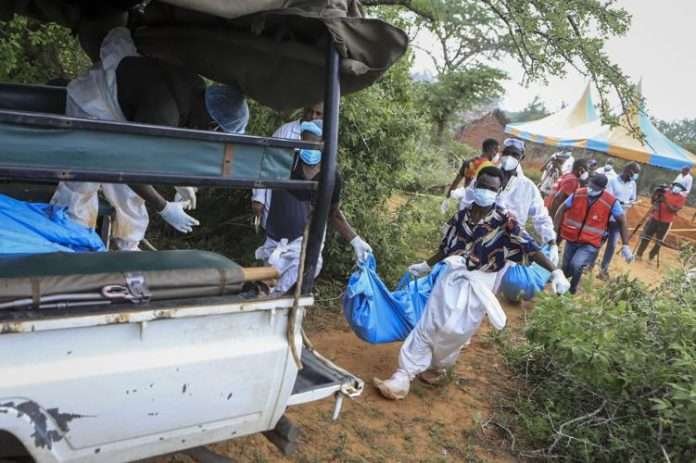
    Nairobi, Kenya.- (African Boulevard News) – The Criminal Investigation Department in Kenya has made yet another gruesome discovery in the south eastern county of Kilifi. Over 45 corpses have been uncovered, most of which were found on a land owned by a self-proclaimed pastor who allegedly encouraged his followers to fast to death.

    The followers were reportedly starving themselves on the pastor’s instructions in order to “meet Jesus.” The pastor, Paul Makenzi of the Good News International Church, has been detained for over a week along with six of his followers. Makenzi has been arrested twice before, in 2019 and in March of this year, in relation to the deaths of children. Each time, he was released on bond, and both cases are still proceeding through the court.

    Local politicians have urged the court not to release Makenzi this time, decrying the spread of cults in the Malindi area. Makenzi’s case will be mentioned in court on May 2nd.

    Tip off from the public

    Police raided Makenzi’s property after a tipoff from members of the public. The raid revealed 15 emaciated people, including the four who later died. The followers said they were starving at the pastor’s instruction in order to meet Jesus.

    Digging started on Friday, April 21st after police received information about dozens of shallow graves spread across Makenzi’s farm. Over 45 corpses have been found so far.

    Hussein Khalid of the rights group Haki Africa has called for psychosocial counselling for members of the cult. He urged that “These are victims, these are not criminals. We need psychosocial counselling so that they can be deradicalised and understand what is happening.”

    The child protection officer in Malindi sub county, Kilifi county was horrified: “The childhood belongs to the family and the community. And here when they were coming out, they were tied with ropes and forced to fast for up to, until they pass on. That is a big blow and a big shock to our country. What cruelty if not this one,” Sebastian Muteti concluded.

    Repeat offender pastor

    This is not the first time Makenzi has been arrested in relation to the deaths of his followers. In 2019 and again in March of this year, he was arrested and released on bond. Both cases are still in court.

    The authorities are facing criticism for releasing Makenzi after the previous arrests. According to reports, local politicians have urged the court not to release him this time, decrying the spread of cults in the area.

    Psychosocial counseling for the victims

    The director of Haki Africa, Hussein Khalid has called for psychosocial counseling for members of the cult. According to him, “These are victims, these are not criminals. We need psychosocial counseling so that they can be deradicalized and understand what is happening.”

    The child protection officer in Malindi sub county, Kilifi county was also horrified, stating that “The childhood belongs to the family and the community. And here when they were coming out, they were tied with ropes and forced to fast for up to, until they pass on. That is a big blow and a big shock to our country. What cruelty if not this one,” Sebastian Muteti concluded.

    Conclusion

    The discovery of over 45 corpses on a farm owned by a self-proclaimed pastor has shocked the country. The pastor has been arrested for allegedly telling his followers to fast to death. The case will be mentioned in court on May 2nd. Local politicians have urged the court not to release him this time, decrying the spread of cults in the area. Psychosocial counseling has been called for the victims of the cult.

    Morocco Hosts One of the Planet’s Toughest Ultramarathons: 1150 Athletes Gather for Marathon des Sables, Facing Heat, Sandstorms, and Tough Terrain.

    0
    Read Time:2 Minute, 53 Second

    Rabat, Morocco.- (African Boulevard News) – More than 1150 athletes from around the world gathered in Morocco to participate in the annual “Marathon des Sables”. This six-day 251 km ultramarathon is considered one of the toughest endurance races on the planet. The race started on Sunday, and the participants will run across the Sahara Desert, facing scorching heat, sandstorms, and tough terrain.

    A Test of Resilience and Endurance

    The “Marathon des Sables” demands exceptional mental and physical strength from its participants. Runners must carry their own food and medical supplies, and they have to manage their water intake to ensure they can make it to the next day’s checkpoint. The race participants must also conquer the challenging sand dunes and rocky hills of the Moroccan desert.

    The starting line of the 2023 race saw some of the most awe-inspiring athletes from around the world, from seasoned ultramarathoners to first-timers who came to test their limits. With the temperature expected to soar above 40°C, runners will have to keep hydrated and be mindful of heatstroke.

    The Favorite and The Challenger

    This year’s race holds the promise of an exciting battle between the Moroccan armada and a French team. Moroccan Rachid El Morabity aims to win for the 10th time to match the record of Lahcen Ahansal. He will face stiff competition from Mathieu Blanchard from France, who could well upset the Moroccan ambitions.

    For the women’s category, the Moroccan athletes are also the favorites, with Aziza El Amrany, who finished third last year, expected to provide some opposition.

    The Race Towards Self-Sufficiency

    Before the race officially started, participants had to undergo medical examination and show that they were carrying the necessary medical supplies to endure the harsh environment. On the day of the race, bags were checked, and the medical staff went through the electrocardiograms of the runners.

    Participants will have to live in self-sufficiency for six days, with only water provided at checkpoints. They will have to ration their food and water to ensure they have enough to reach the next checkpoint.

    “It’s up to us to manage our days,” said Jérôme Martos, a runner, who was all set to begin the race.

    The Spirit of the Marathon

    The marathon is more than just a race. It is a symbol of human endurance, resilience, and determination. Runners come from different backgrounds, languages, and cultures, but they all share one goal: to push their limits and reach the finish line.

    The “Marathon des Sables” has come to represent the spirit of perseverance, respect, and solidarity among the participants. Runners help each other out, share their supplies, and offer words of encouragement to keep their spirits high.

    A True Test of Human Limits

    The “Marathon des Sables” is not just a race but a true test of the human spirit. It is a race against the elements, the terrain, and one’s own limitations. The six-day ultramarathon requires participants to be physically and mentally strong, driven by sheer willpower and determination.

    As runners make their way across the Moroccan desert, they will face fatigue, hunger, and intense heat. The only thing standing between them and the finish line is their own resilience.

    The “Marathon des Sables” is a testament to the human spirit’s tenacity, courage, and determination to overcome seemingly impossible challenges. As the runners push themselves to the limit, they inspire others to believe that anything is possible with hard work, focus, and determination.